
Boulder County Property Tax Guide: Rates & Hazards by ZIP
How property tax and hazard exposure vary across Boulder County, Colorado by ZIP code: actual value, tax districts and local hazards.
9 min read1,711 wordsZip Cost Ledger editorial
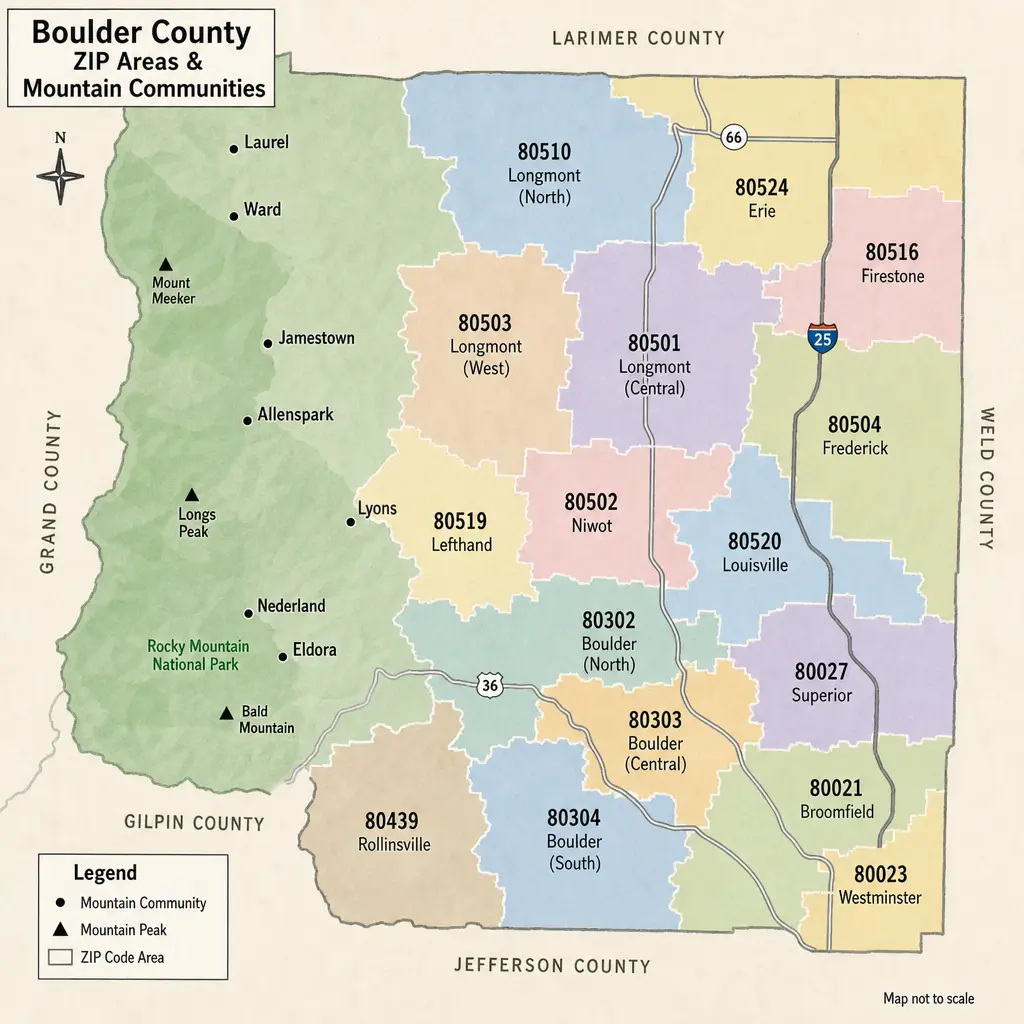
Boulder County property taxes can look different from one ZIP code to the next, but ZIP codes are only a starting point. The real bill is driven by a property’s actual value, Colorado assessment rules, and the specific school, city, fire, library, water, and special districts tied to that parcel. This guide explains how to read Boulder County taxes by area, how hazard considerations fit into the picture, and what to check before buying, budgeting, or comparing homes.
Can you really compare property tax by ZIP?
Yes, you can use ZIP codes to narrow your search, but you should not treat them as tax boundaries. A search for property tax by zip can help you compare neighborhoods in Boulder, Longmont, Lafayette, Louisville, Superior, Nederland, Lyons, or unincorporated mountain areas, yet Boulder County calculates taxes at the parcel and tax-area level, not simply by postal code. The county explains that each property’s location determines which mill levies apply, including school districts, water districts, fire districts, and other local governments. (bouldercounty.gov)
That distinction matters because one ZIP code can cross city limits, school district lines, fire protection districts, and unincorporated areas. Two homes with the same ZIP and similar market values may receive different Boulder County taxes if they sit in different tax areas. For the most accurate estimate, use the Boulder County Assessor property search to look up the parcel’s tax area, assessed value, total mill levy, and estimated tax. (maps.bouldercounty.org)
Map-style view of Boulder County ZIP areas and mountain communities
The basic formula behind Boulder County taxes
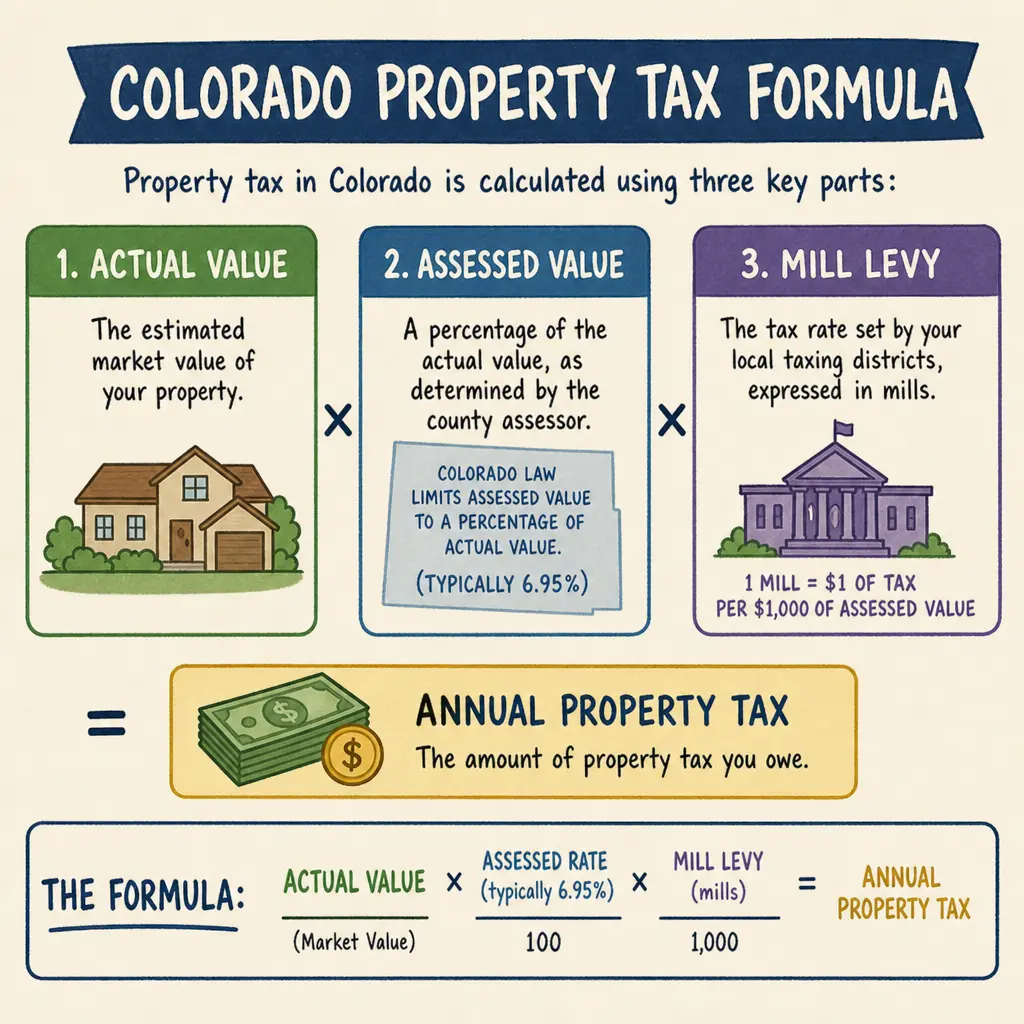
Colorado property tax is built from three main pieces: actual value, assessment rate, and mill levy. The assessor determines actual value, the state sets assessment rates, and local taxing authorities set mill levies. Boulder County’s property search summarizes the basic calculation as actual value, adjusted where applicable, multiplied by the assessment rate and then by the mill levy. (maps.bouldercounty.org)
For residential property, Boulder County lists separate calculations for school districts and other local governments beginning with tax year 2025, payable in 2026. For 2025, the residential assessment rate is 7.05% for school districts and 6.25% for local government. For 2026, the school district rate remains listed at 7.05%, while the local government rate is listed at 6.8%, with a value reduction equal to 10% of the first $700,000 in actual value for the local government portion. (bouldercounty.gov)
A simplified way to think about boulder co property tax is:
- Start with the property’s actual value.
- Apply the correct assessment rate for the property type and tax year.
- Multiply the assessed value by the mill levy for each applicable taxing authority.
- Add the school and non-school portions together.
- Confirm exemptions, deferrals, or special circumstances before relying on the number.
This is why boulder colorado real estate taxes do not rise or fall only because a home’s market value changes. They also depend on district budgets, voter-approved taxes, state assessment rules, and whether the property qualifies for relief programs.
County tax rates are made of many local layers
When people ask about county tax rates, they often expect one Boulder County number. In reality, the final rate is a stack of levies from multiple entities. Boulder County collects and distributes property tax for many taxing entities, and the county itself receives only a portion of the total collected. (bouldercounty.gov)
For fiscal year 2026, Boulder County approved a countywide levy of 24.046 mills, including a temporary mill levy credit. That county levy is important, but it is not the whole bill. The Treasurer calculates property tax using the mill levies from all taxing entities that apply to the individual property. (bouldercounty.gov)
Common taxing layers may include:
- Boulder County government, including general county services and voter-approved funds.
- School districts, often one of the largest parts of a residential tax bill.
- Municipal governments, such as Boulder, Longmont, Lafayette, Louisville, or other incorporated areas.
- Fire protection districts, especially important in foothills and unincorporated communities.
- Library, water, sanitation, recreation, and special districts, depending on the parcel.
Because these layers change by geography, “boulder property tax” is really shorthand for a local bundle of tax obligations attached to a specific address.
How ZIP codes shape the conversation
ZIP codes are still useful because they organize how buyers and owners think about location. A person searching “Boulder County, Colorado — property tax and hazard by ZIP code” is usually trying to answer two practical questions: What might I owe, and what risks should I understand before I commit to a property?
Here is a practical way to use ZIP codes without overreading them:
- Boulder ZIPs such as 80301, 80302, 80303, 80304, and 80305 can include different city, school, open space, floodplain, and foothills considerations depending on the address.
- Longmont-area ZIPs such as 80501, 80503, and 80504 may include Boulder County parcels, Weld County parcels, municipal areas, and different district combinations.
- Lafayette, Louisville, and Superior ZIPs such as 80026, 80027, and 80020 can have different city and special district tax structures even when homes feel close together.
- Mountain and foothills ZIPs such as 80455, 80466, and 80481 may raise additional questions about fire districts, access, mitigation requirements, and insurance availability.
These examples are not substitutes for a parcel lookup. They are a reminder that ZIP-level comparisons should lead you to more precise address-level research.
What hazards should you check by ZIP code?
The most important Boulder County hazards to review are wildfire and flood risk, but official hazard research should happen by address or parcel, not by ZIP alone. Boulder County’s floodplain resources note that everyone has some flood risk, mapped floodplains cover multiple drainages, and properties outside a regulatory floodplain can still have flood exposure. The county also provides an interactive regulatory floodplain map and states that the Assessor’s property search includes flood risk by address. (bouldercounty.gov)
Wildfire risk is also highly location-specific. Boulder County’s Wildfire Mitigation division works to reduce wildfire risk and improve resilience in unincorporated areas, and the county’s Community Wildfire Protection Plan provides a countywide strategy for wildfire risk assessment and mitigation priorities. (bouldercounty.gov)
When reviewing hazard by ZIP code, use the ZIP as a screening tool, then check:
- Whether the parcel is in or near a regulatory floodplain.
- Whether the property is in the wildland-urban interface or a mapped wildfire zone.
- Whether the home has defensible space, hardened materials, and safe access routes.
- Whether insurance carriers require additional mitigation, higher deductibles, or special underwriting.
- Whether future improvements may trigger floodplain, wildfire, or land-use requirements.
Hazard exposure may not directly change the county’s tax formula, but it can affect total ownership cost through insurance, maintenance, mitigation work, financing concerns, and resale expectations.
Why assessed value and market value are not the same experience
A home’s market value is what buyers might pay under current conditions. Assessed value is the taxable value created after applying Colorado property tax rules. Boulder County noted that 2025 was a state-mandated valuation year, meaning the Assessor’s Office was required to revalue real property in the county. (bouldercounty.gov)
That revaluation cycle can make tax planning feel uneven. A homeowner may see a new notice of value before the final tax bill is available, because mill levies are not finalized until taxing entities complete their budget process. Boulder County states that the Treasurer cannot provide accurate tax estimates until all taxing entities determine their mill levies and the Certified Tax Roll is received. (bouldercounty.gov)
For homeowners, the practical lesson is simple: do not budget from assessed value alone. For buyers, do not assume the seller’s past tax bill will match your future bill. A change in value, tax-area boundaries, exemptions, or assessment rules can shift the amount due.
A practical checklist for buyers and homeowners
Before comparing colorado property tax across Boulder County ZIPs, gather the same information for each property. Consistent inputs make the comparison more useful and reduce surprises.
Use this checklist:
- Look up the parcel in the Boulder County Assessor property search.
- Record the actual value, school assessed value, non-school assessed value, tax area, and total mill levy.
- Review the most recent tax notice through the Treasurer’s tax tools.
- Check whether the property is inside city limits or unincorporated Boulder County.
- Identify the school district, fire district, and any special districts.
- Check floodplain status using county floodplain resources.
- Review wildfire mitigation resources if the home is in the foothills, mountains, or edge-of-open-space areas.
- Ask about senior, veteran, or deferral programs only if they apply to the owner’s situation.
- Recalculate affordability using taxes, insurance, HOA dues, utilities, and likely maintenance.
The Treasurer’s Office mails tax notices in late January and allows property owners to pay in one payment or two equal payments. It also provides online payment options and tax notice tools. (bouldercounty.gov)
The takeaway for ZIP-level tax research
Boulder County tax research starts with a ZIP code, but it should never end there. ZIPs help you compare broad location patterns, while parcel-level records reveal the actual tax area, mill levies, assessed values, and estimated taxes. That is the difference between a rough online search and a reliable ownership-cost estimate.
If you are evaluating boulder county taxes, use ZIP codes to organize your shortlist, then verify each address through official Boulder County tools. Pair the tax review with flood and wildfire research so your decision reflects the full cost of owning in Boulder County, not just the purchase price or a single line on the tax bill.
Common questions
Are Boulder County property taxes identical across a single ZIP code?
No, because ZIP codes do not define tax boundaries. A single ZIP code can overlap with multiple municipalities, school districts, and special districts, meaning two homes in the same ZIP can have different tax rates.
How does the Boulder County Assessor calculate my final property tax amount?
The assessor starts with the property's actual value, applies the Colorado assessment rate to find the assessed value, and then multiplies that by the combined mill levy for all the specific taxing authorities serving that parcel.
Does the school district assessment rate differ from the local government assessment rate?
Yes, beginning with the tax year 2025, Colorado property tax rules separate residential assessment rates. There is one rate applied for school district taxes and a slightly different rate applied for other local government levies.
Related guides
Morgan County Property Tax & Hazard Guide: ZIP Code Insights
Property taxes in Morgan County, Colorado are shaped by your property’s actual value, its state-defined assessment rate, and the mill levies charged by the county, school district, municipality, and special districts that serve your parcel. That is why two properties with similar market values can have different bills when they sit in different tax areas, school boundaries, or service districts. This guide explains how Morgan County property tax works, how to read property tax rates, and why pairing tax by ZIP with a hazard assessment can give homeowners, buyers, and investors a clearer view of total property risk.
· 9 min read
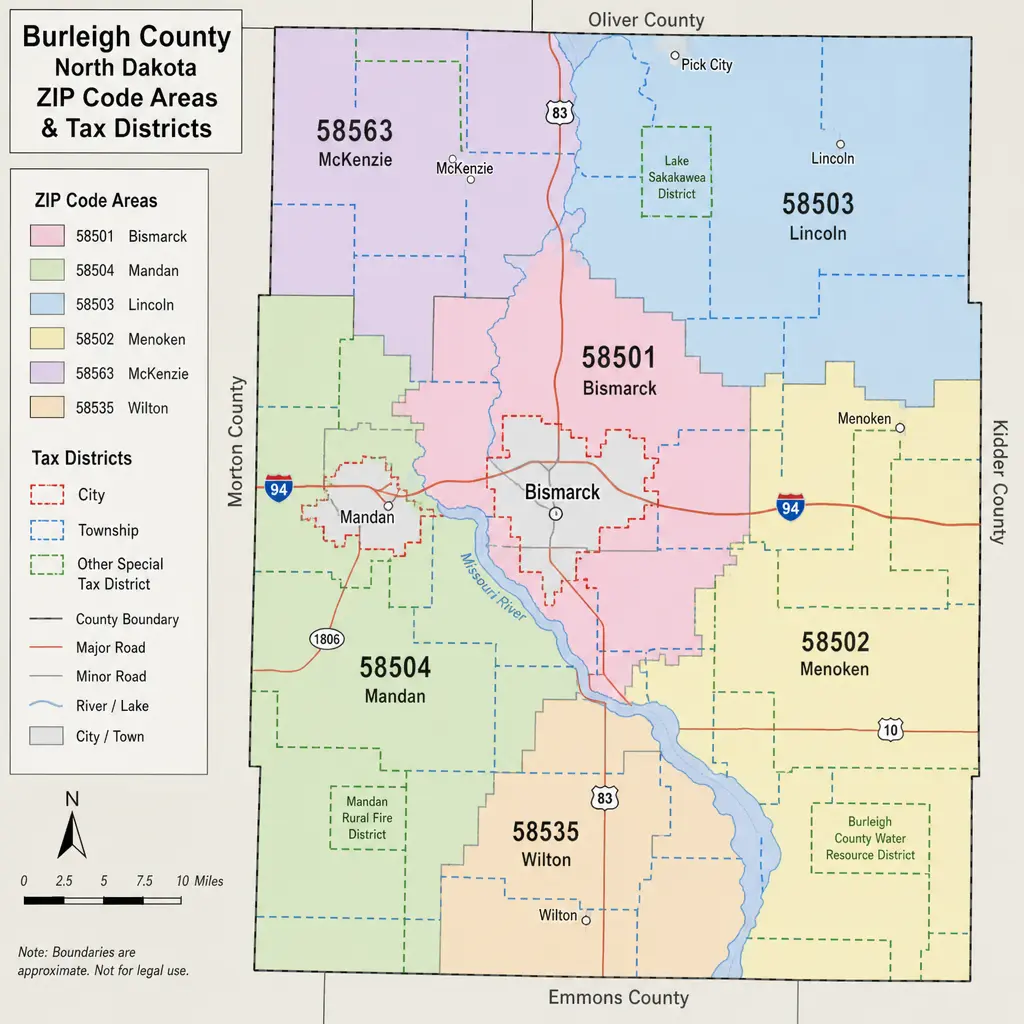
Burleigh County Property Tax & Hazard Guide by ZIP
Burleigh County property tax is based on property value, taxable classification, and the mill levies assigned to the property’s taxing district—not simply on the ZIP code printed in the mailing address. For homeowners, buyers, and investors comparing Burleigh County, North Dakota — property tax and hazard by ZIP code, the smartest approach is to use ZIP codes as a starting point, then confirm the parcel’s city, township, school district, special assessments, and local hazard context.
· 7 min read
Mesa County Property Tax & Hazard Guide by ZIP
Mesa County property taxes are based on a Colorado assessment system, not a single countywide percentage you can apply to every home. Your bill depends on your property’s actual value, its assessed value, the taxing districts tied to the parcel, and any applicable local or special district levies.
· 9 min read