
California Property Tax Rates by County & ZIP
California property tax rates by county and ZIP code, how the bill is calculated, and what drives the variation from one area to the next.
8 min read1,623 wordsZip Cost Ledger editorial
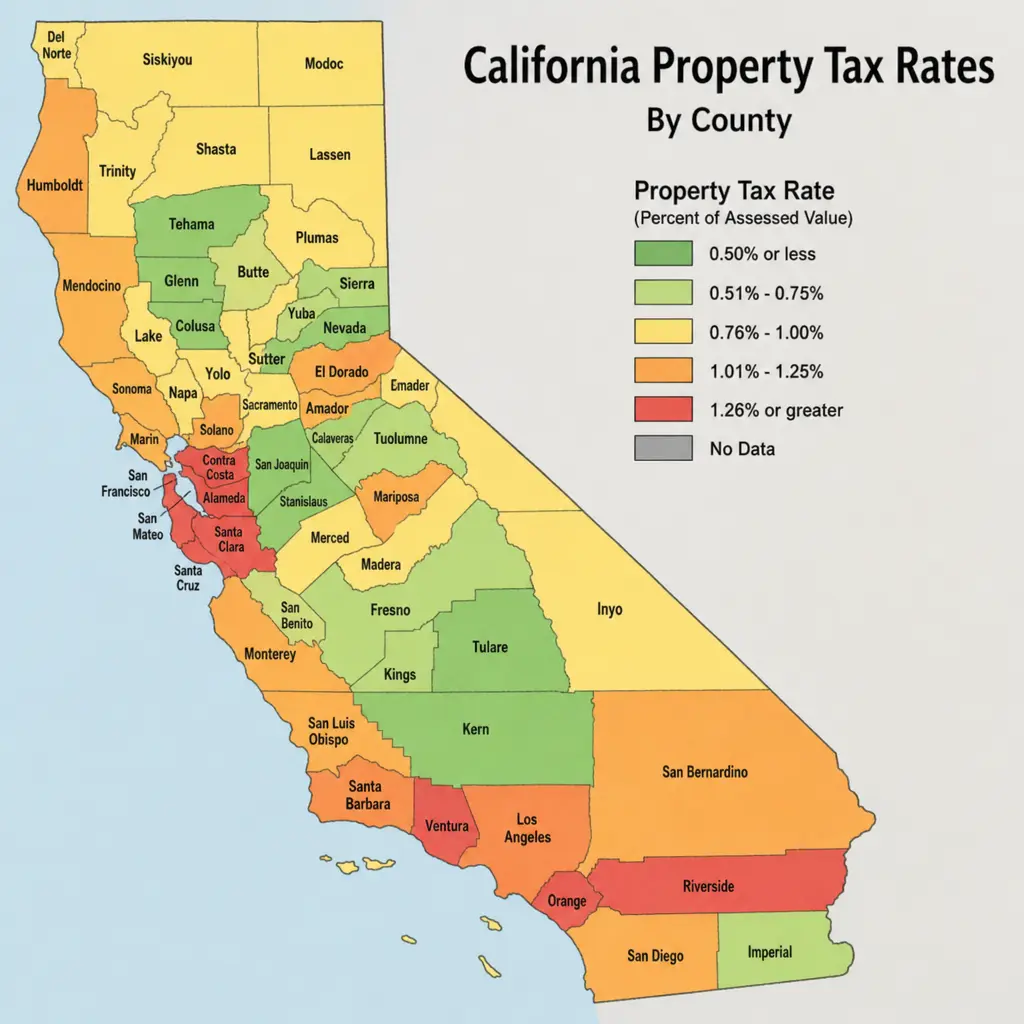
California property taxes are easier to understand once you separate the statewide rule from the local add-ons. In most cases, property tax in CA starts with a 1% general levy on assessed value, then county, city, school, and special district charges can change the final bill. This guide explains how property tax California calculations work, why rates vary by county and neighborhood, and how to look up the most reliable property tax information California homeowners and buyers need.
How much is the property tax in California?
The short answer is that California’s base property tax rate is generally 1% of taxable assessed value, but the amount on a real bill is usually higher after voter-approved debt rates and local direct assessments are included. The California State Board of Equalization explains that Proposition 13 limits the basic property tax rate to 1% of assessed value, while allowing added rates for voter-approved indebtedness that can vary from area to area within a county. (boe.ca.gov)
That means there is no single ca property tax rate that applies perfectly to every parcel. A home in one tax rate area may have a different total bill than a similar home a few blocks away, especially if one property sits inside a school bond district, community facilities district, or other local assessment area. For planning purposes, buyers often estimate around the low 1% range, but the official answer always comes from the parcel’s county records.
It also helps to understand what the percentage is applied to. For most real property under Proposition 13, assessed value generally starts at market value when ownership changes or new construction is completed, then increases annually by an inflation adjustment capped at 2%, unless another reassessment event occurs. (boe.ca.gov)
The statewide rule and the local reality
California real estate tax is often described as “1%,” but that phrase is only the foundation. The full bill may include the general 1% levy, debt service for voter-approved bonds, and fixed charges or special assessments that are not always expressed as a simple percentage of value. This is why two homes with the same purchase price can have different annual tax bills.
The county assessor, auditor-controller, and tax collector each play a role. In general, the assessor establishes taxable value, the auditor-controller applies tax rates and direct assessments, and the tax collector bills and collects the amount due. Los Angeles County’s property tax overview describes this kind of process: the Assessor establishes value, and the Auditor-Controller applies the general 1% levy, debt service rates, and direct assessments to create the assessment roll. (propertytax.lacounty.gov)
For homeowners, the practical lesson is simple: do not rely only on a statewide average or a real estate listing estimate. Use averages to compare counties, but use the parcel number, address, or tax rate area when you need the amount you are likely to pay.
California property tax rates by county and ZIP code are only a starting point
Searches for “California property tax rates by county and ZIP code” are common because buyers want a quick way to compare affordability. County averages are helpful for a broad view, and ZIP codes can narrow your search, but neither one is as precise as the property’s tax rate area and parcel record.
The Board of Equalization’s 2024-25 Annual Report lists average property tax rates for all 58 counties. In that report, examples range from Modoc and Sierra at 1.000% to higher average-rate counties such as Alameda at 1.220% and Kern at 1.248%. Other examples include Orange at 1.064%, Los Angeles at 1.181%, San Diego at 1.171%, and Santa Clara at 1.193%. (boe.ca.gov)
Those averages are useful, but they do not guarantee the rate for a specific home. Within a county, tax rate areas can differ based on local bond measures and district boundaries. The BOE has also noted that California uses thousands of tax rate areas to allocate local tax revenue, which is why parcel-level verification matters. (boe.ca.gov)
ZIP codes can be even less exact. A ZIP code may cross city, school district, or special district lines. When you are comparing neighborhoods, ZIP-level research can help you form a rough expectation, but the official property tax california answer comes from the county tax bill or county tax rate lookup.
What actually makes one county’s rate different?
County averages differ because local voters and local districts differ. Proposition 13 created a statewide framework, but it did not erase local financing decisions. When voters approve bonds for schools, infrastructure, or other public purposes, the debt service can appear as an added rate in affected areas.
Here are the main factors that can shape the final California real estate tax rate:
- General 1% levy: The statewide base applied to taxable assessed value.
- Voter-approved bonds: Added rates used to pay qualifying local indebtedness.
- Direct assessments: Fixed charges for services or districts, which may include items such as lighting, landscaping, flood control, or community facilities.
- Mello-Roos or community facilities districts: Special taxes that may apply in some newer developments or designated districts.
- Assessed value history: A longtime owner may have a much lower assessed value than a recent buyer of a similar property because of Proposition 13 assessment limits.
- Exemptions: Eligible homeowners, disabled veterans, nonprofits, and other qualifying property owners may receive exemptions that reduce taxable value or taxes owed.
The BOE’s annual report notes that the Homeowners’ Exemption typically provides a $70 reduction in property taxes for owner-occupied homes, while other exemptions may apply to qualifying organizations or disabled veterans. (boe.ca.gov)
How to estimate a California property tax bill before you buy
A good estimate combines the statewide formula with local research. It will not replace the official bill, but it can keep you from being surprised during escrow or after closing.
Use this checklist:
- Start with the likely assessed value. For a purchase, that is often close to the purchase price, though the assessor makes the official determination.
- Apply the 1% base levy. A $900,000 assessed value would produce a base levy of about $9,000 before local add-ons.
- Check the county average. Use the BOE’s county average as a broad reasonableness check, not as a parcel-specific answer.
- Look up the parcel or tax rate area. County tax portals often let you search by address or assessor’s parcel number.
- Review direct assessments. These can materially affect the annual cost because they may not behave like a percentage of value.
- Ask about supplemental taxes. If you are buying, the regular tax bill may still reflect the seller’s assessed value, and a supplemental bill may arrive later.
The supplemental assessment system is important for new owners. BOE guidance explains that when property changes ownership or new construction is completed, a supplemental assessment can reflect the increase or decrease in assessed value for the remaining part of the fiscal year. An increase can lead to a supplemental tax bill, while a decrease can result in a refund. (boe.ca.gov)
Why your tax bill can change after closing
Your first tax bill after buying a California home may not show the full post-sale amount. If the county has not yet processed the reassessment, the bill may still be based on the prior owner’s assessed value. Later, you may receive a supplemental bill for the difference between the old assessed value and the new assessed value for the applicable period.
This is one of the most common areas of confusion for buyers. A mortgage estimate may include a property tax reserve, but that does not always mean every future supplemental amount has been collected in advance. If you are budgeting tightly, set aside extra funds until the county has completed the reassessment and you have seen the updated annual tax amount.
Annual timing matters too. California’s property tax calendar shows that the January 1 lien date is central to the assessment year, the first secured installment is due November 1, and the second secured installment is due February 1, with penalty deadlines later in December and April. (taxes.ca.gov)
Where to find reliable property tax information in California
The best property tax information California residents can use usually comes from official state and county sources. Statewide explanations are helpful for learning the rules, while county portals are better for a specific property.
For a parcel-specific search, gather:
- The property address
- The assessor’s parcel number, often called the APN
- The county name
- The current tax bill, if available
- The tax rate area, if the county provides it
- Any special assessment or Mello-Roos disclosure documents
Then check the relevant county assessor, auditor-controller, and tax collector pages. Some counties combine these tools in a single property tax portal, while others separate valuation, rate, and payment information across departments. Los Angeles County, for example, provides a tax rate area lookup through the Auditor-Controller and a broader property tax portal for taxpayers. (onlineapps.auditor.lacounty.gov)
When comparing counties, use BOE data for averages and statewide context. The BOE reported that California’s net assessed property value for the January 1, 2025 lien date reached $9.1 trillion, including about $9.0 trillion in county-assessed property and $165 billion in state-assessed property. (boe.ca.gov)
A practical takeaway for buyers and owners
California property tax is simple at the base and detailed at the parcel level. The 1% Proposition 13 levy gives you a starting point, but the final bill depends on assessed value, county average rates, voter-approved debt, direct assessments, exemptions, and the exact tax rate area.
If you are asking, “how much is the property tax in California,” the best answer is: start with 1% of assessed value, then verify the local additions through the county. County and ZIP code research can help you compare markets, but the parcel record is what turns an estimate into a usable budget number.
Related guides
New Jersey Property Tax Rates: County & ZIP Guide
New Jersey property tax rates can feel confusing because they are local, not statewide, and the number you see online may not be the number used to calculate your actual bill. This guide explains how NJ property tax works, why rates vary so much by municipality, and how to look up reliable property tax information NJ homeowners, buyers, and investors can use.
· 10 min read
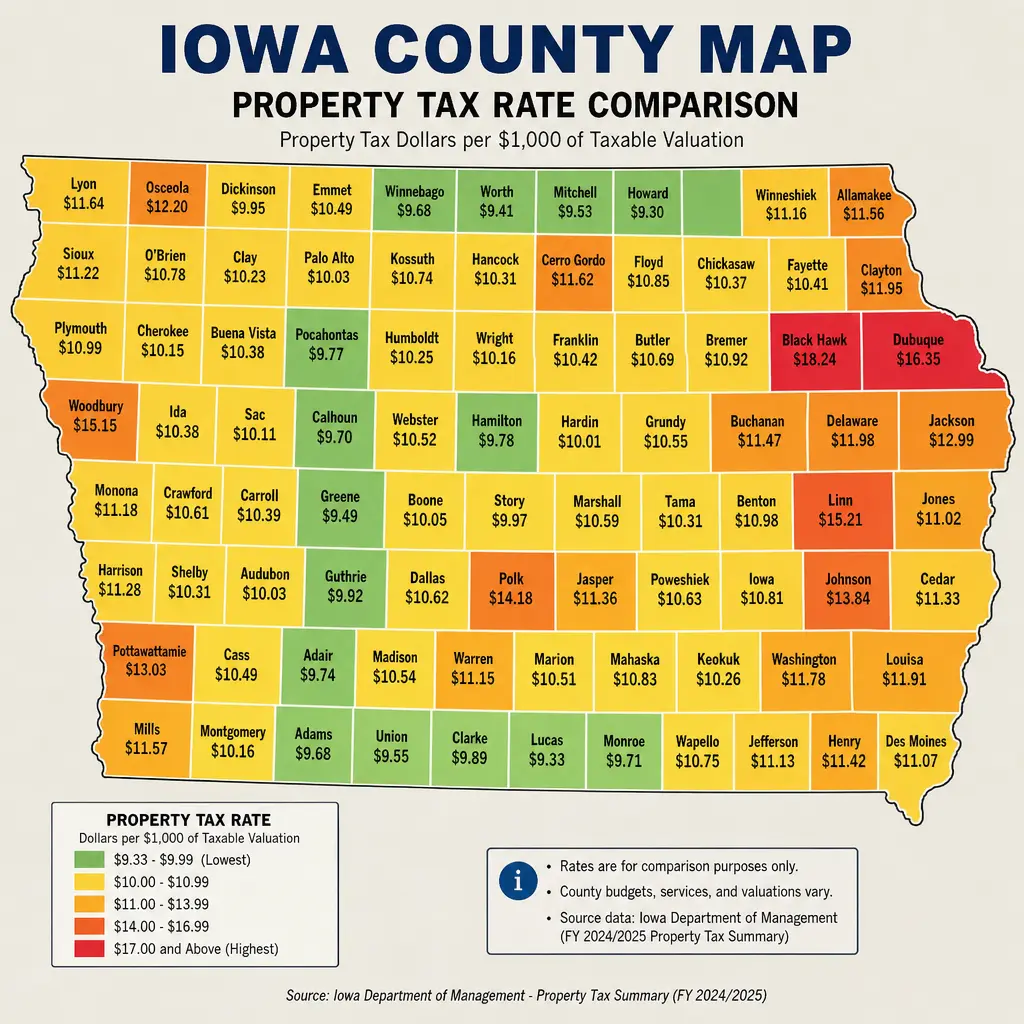
Iowa Property Tax Rates by County & ZIP Guide
Iowa property taxes are local taxes, so the rate attached to a home depends on more than the county name on the deed. Your bill is shaped by your property’s taxable value, its classification, the levy rates for every local authority serving that address, and any credits or exemptions that apply.
· 9 min read
Jackson County, Colorado Property Tax Guide
Property tax rates in a place called Jackson County can be confusing because there are many Jackson Counties, plus cities named Jackson in different states. This guide explains how Jackson County property tax rates are usually calculated, how to use a Jackson County property tax lookup, and why location, assessment rules, exemptions, and hazard considerations can change what a property owner actually pays.
· 7 min read