
Iowa Property Tax Rates by County & ZIP Guide
Learn how to read Iowa property tax rates by county and ZIP code, and understand the levy rates shaping your property tax bill in Iowa.
9 min read1,888 wordsZip Cost Ledger editorial
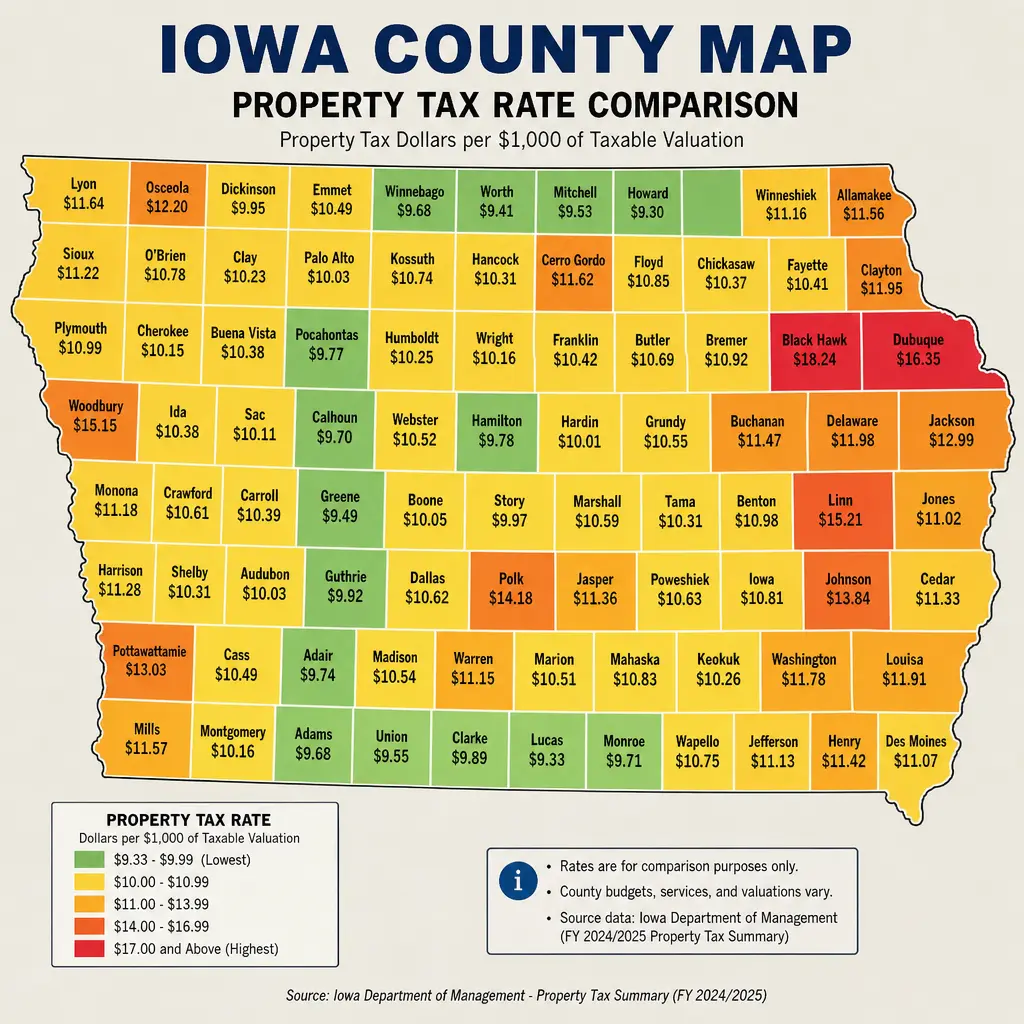
Iowa property taxes are local taxes, so the rate attached to a home depends on more than the county name on the deed. Your bill is shaped by your property’s taxable value, its classification, the levy rates for every local authority serving that address, and any credits or exemptions that apply. This guide explains how to read Iowa property tax rates by county and ZIP code, why neighboring homes can owe different amounts, and how property taxes fit alongside the broader Iowa tax rate picture.
What determines Iowa property tax rates by county and ZIP code?
Iowa property tax rates by county and ZIP code are determined by the taxing district tied to a specific property, not by ZIP code alone. A county auditor combines the levy rates for the county, city or township, school district, and other local authorities that apply to that parcel; the resulting consolidated levy rate is expressed in dollars per $1,000 of taxable value. The Iowa Department of Revenue notes that local assessors establish valuation and classification, while county auditors determine levy rates based on local budgets and tax bases. (revenue.iowa.gov)
That is why a countywide average is useful for comparison but not enough for budgeting. Two homes in the same county may sit in different school districts, city limits, townships, emergency service areas, or special taxing districts. Two homes in the same ZIP code may even be in different counties or taxing jurisdictions.
If you are estimating Iowa real estate taxes for a purchase, refinance, or relocation, start with the parcel address rather than a broad county search. The exact tax district is what connects the property to the levy rates that appear on the tax statement.
Iowa county map with property tax rate comparison highlights
County rates are a starting point, not the whole bill
County-level data helps you see the general landscape of state of Iowa property taxes. For FY 2026, the Legislative Services Agency’s county property tax levy rate map lists a statewide urban county rate average of $6.01 per $1,000 of taxed value and a statewide rural county rate average of $9.29 per $1,000 of taxed value. The same source shows wide county variation, with urban county rates ranging from $2.45 to $10.12 per $1,000 of taxed value. (legis.iowa.gov)
Those county rates, however, reflect only the county portion of the property tax picture. A homeowner’s full consolidated levy usually includes several other layers. In many Iowa communities, schools, cities, and counties make up most of the property tax collected statewide, according to the Iowa Department of Management. (dom.iowa.gov)
Common components include:
- County levies: fund countywide services such as administration, law enforcement, public health, roads, and other county responsibilities.
- City or township levies: apply based on whether the property is inside city limits or in an unincorporated area.
- School district levies: often represent a major share of the total levy rate and can vary within the same county.
- Special levies: may support assessors, community colleges, emergency services, agricultural extension, debt service, or other authorized local functions.
- Tax increment financing areas: can affect how tax revenue is allocated and may complicate comparisons between properties.
The practical takeaway is simple: county rankings can help you narrow your research, but the parcel-level levy rate is the number that matters when estimating a bill.
How Iowa property taxes are calculated
The core formula is straightforward: taxable valuation divided by 1,000, multiplied by the tax rate, equals property tax dollars before applicable credits. The Iowa Department of Management explains that Iowa property tax rates are expressed in dollars and cents per $1,000 of taxable property valuation. (dom.iowa.gov)
A simplified example looks like this:
- A home has an assessed value set by the local assessor.
- Iowa’s assessment limitation, often called a rollback, determines the taxable portion for that property class.
- The property’s tax district determines the consolidated levy rate.
- The taxable value is divided by 1,000.
- That number is multiplied by the levy rate.
- Credits or exemptions are subtracted from the final tax bill if the property qualifies.
For example, if a property has $180,000 in taxable value and a consolidated levy rate of $30 per $1,000, the levy calculation would be 180 multiplied by 30, or $5,400 before credits. This is only an illustration, not a statewide average or a prediction for any specific county.
This also explains why Iowa property taxes can rise even when the stated levy rate falls. If taxable valuation increases enough, the final bill may still go up. Conversely, a higher levy rate does not always mean a higher bill if taxable value is lower or credits reduce the amount owed.
Why do Iowa real estate taxes vary so much?
Iowa real estate taxes vary because each property sits inside a unique combination of taxing authorities and has its own taxable value. County boundaries matter, but they are only one part of the system. School district lines, city services, local debt, voter-approved levies, property classification, and tax credits can all change the final amount.
Here are the biggest reasons bills differ:
- Local budgets: Local governments set budgets for services, then levy property taxes within the authority allowed by Iowa law.
- Taxable valuation: A property with a higher taxable value generally pays more than a similar property with a lower taxable value in the same district.
- Property classification: Residential, agricultural, commercial, industrial, and utility property are treated differently in the assessment system.
- Urban versus rural location: Rural properties may not pay city levies, but they may be subject to rural service levies.
- School district boundaries: A city or ZIP code can include more than one school district, which can change the consolidated levy.
- Credits and exemptions: Homestead, military, family farm, agricultural land, and other programs may reduce the final bill for qualifying owners.
The Iowa Department of Revenue describes Iowa property tax as primarily a tax on real property, including land, buildings, structures, and other improvements attached to land. It also identifies residential, agricultural, commercial, industrial, and state-assessed utility or railroad property as major classes. (revenue.iowa.gov)
How to look up the right rate for a specific property
For the most accurate estimate, use official parcel-level sources rather than relying on a statewide average. The State of Iowa publishes levy authority rate data by fiscal year, and the dataset defines property tax rates as dollars collected per $1,000 of taxable value. It also notes that the fiscal year runs July 1 through June 30 and is numbered for the calendar year in which it ends. (catalog.data.gov)
A practical lookup process:
- Find the parcel record. Use the county assessor or county GIS site to confirm the parcel number, assessed value, classification, and taxing district.
- Review the tax statement. The county treasurer or county tax portal typically shows prior-year taxes, installments, and credits.
- Check the auditor’s levy information. County auditors calculate and certify rates for taxing entities such as schools, cities, and townships.
- Confirm whether the property is inside city limits. This can significantly affect the consolidated levy.
- Compare by tax district, not just ZIP code. For Iowa property tax rates by county and ZIP code, the ZIP code can help locate an area, but the parcel’s tax district is the better comparison unit.
- Ask about pending changes. New assessments, local budget changes, or credit eligibility can affect future bills.
For buyers, it is wise to look beyond the seller’s current tax amount. The present owner may have exemptions you will not receive, or the property may be reassessed after a sale or improvement. Treat the current bill as a clue, not a guarantee.
Iowa property taxes and the broader Iowa tax rate picture
Property tax is separate from income tax, sales tax, and other state taxes. When people search for the Iowa tax rate, they may be looking for several different things: the Iowa state tax rate on income, the state sales tax rate, or local property tax levy rates. Mixing them together can lead to bad estimates.
For individual income tax, the Iowa Department of Revenue announced that Iowa law provides a flat 3.8% rate, and that in 2026 all levels of taxable individual income are subject to that rate. (revenue.iowa.gov) In plain terms, the Iowa income tax rate and Iowa state income tax rate are statewide rules, while Iowa property taxes are local and property-specific.
That distinction matters when comparing affordability. A lower Iowa state tax rate does not automatically mean lower housing costs in every county. Likewise, a higher local property tax bill does not tell you what a household will owe in income tax. To understand the full cost of living, compare mortgage costs, insurance, utilities, local levies, the iowa state income tax rate, and any applicable credits together.
Key takeaways for homeowners and buyers
If you only remember a few things about Iowa property taxes, make them these:
- County rates are useful for broad comparison, but the consolidated levy rate for the property’s tax district drives the bill.
- ZIP codes are imperfect because they can cross county, city, township, and school district boundaries.
- Taxable value is not always the same as market value or assessed value.
- A changing assessment can affect your bill even if levy rates do not rise.
- Credits and exemptions can make two similar homes pay different amounts.
- The iowa state tax rate for income is separate from property taxes and should not be used to estimate a real estate tax bill.
A clear way to compare counties
When comparing counties, use a layered approach. First, review countywide urban and rural levy data to understand the general pattern. Then narrow the search to cities, school districts, and specific neighborhoods. Finally, check actual parcel records and tax statements for homes similar to the one you own or plan to buy.
This approach keeps the numbers grounded. Instead of asking, “What are Iowa property taxes in this county?” ask, “What is the taxable value, consolidated levy rate, and credit status for this specific property?” That question will get you much closer to the real cost.
Iowa property tax rates by county and ZIP code can look complicated at first, but the system becomes easier once you separate county averages from parcel-level levy rates. Use county data for context, official local records for estimates, and the full tax statement for the clearest picture of what a property owner actually pays.
Common questions
Why does a countywide property tax average not accurately predict my Iowa property tax bill?
Because property taxes are built from multiple local levies. A county average does not account for the specific school district, city, or special taxing authorities that apply to your exact address, all of which change the consolidated levy rate.
Does a lower Iowa state income tax rate mean I will pay lower property taxes?
No. The Iowa state income tax is a statewide rate set by the state legislature, whereas property taxes are determined locally based on city, county, and school district budgets. They are entirely separate taxes.
What causes my Iowa real estate taxes to increase if the levy rate stays the same?
If the assessor increases your property's taxable valuation or if you lose a credit or exemption you previously had, your final tax bill will increase even if the underlying levy rate has not changed.
Related guides
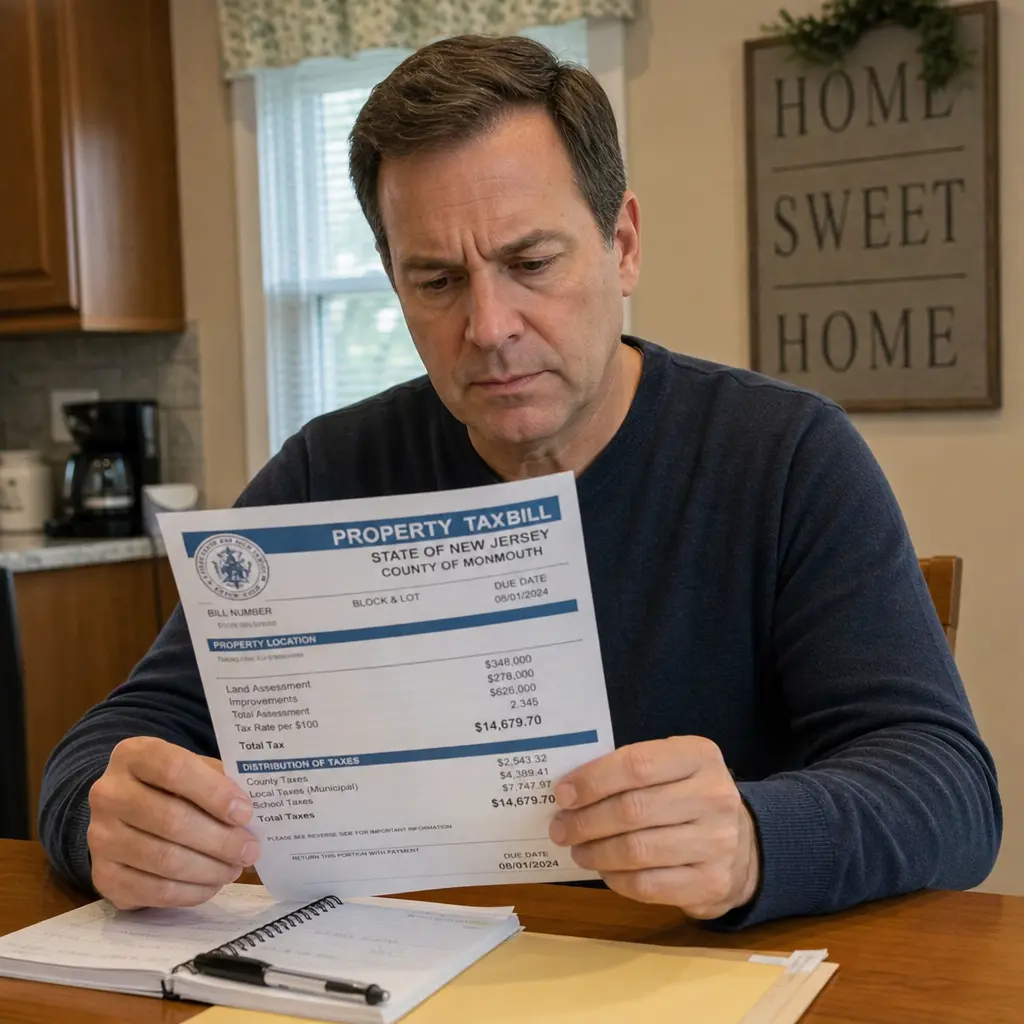
New Jersey Property Tax Rates: County & ZIP Guide
New Jersey property tax rates can feel confusing because they are local, not statewide, and the number you see online may not be the number used to calculate your actual bill. This guide explains how NJ property tax works, why rates vary so much by municipality, and how to look up reliable property tax information NJ homeowners, buyers, and investors can use.
· 10 min read
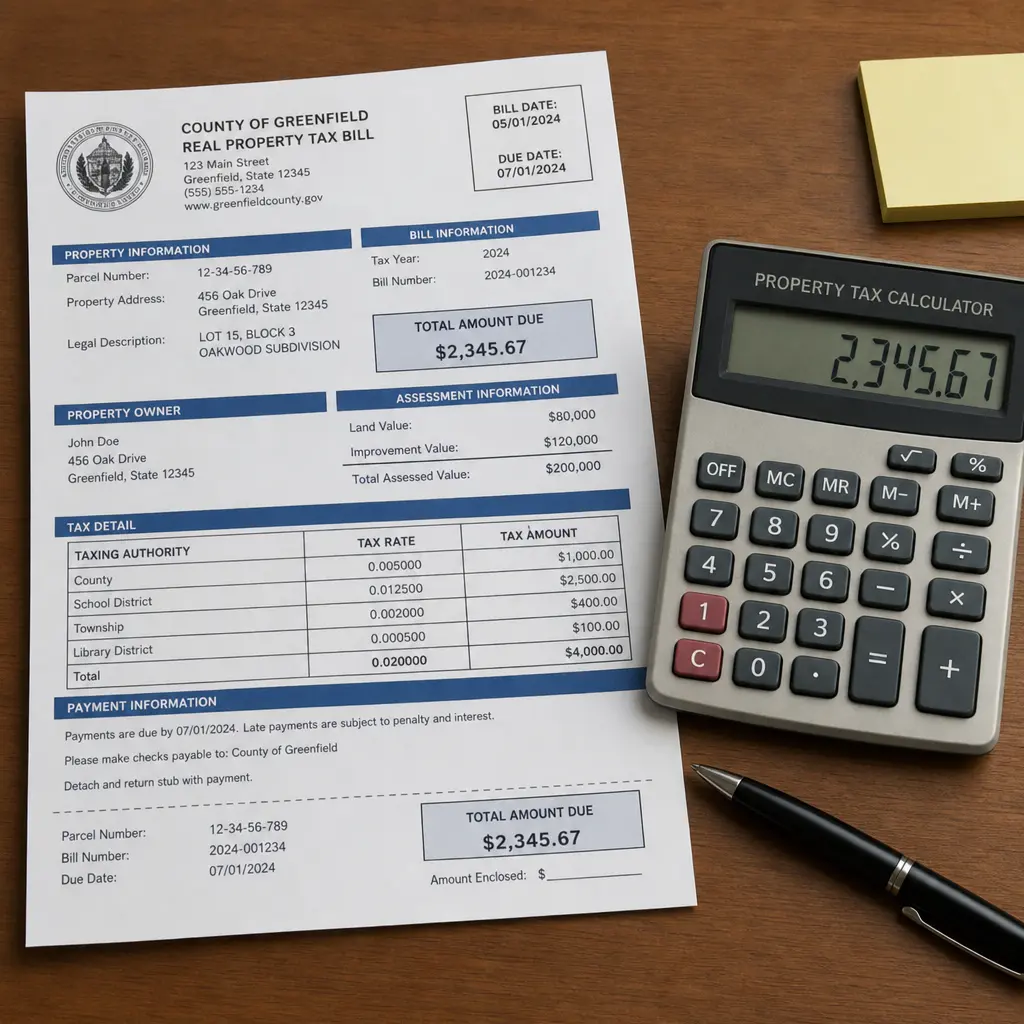
Jackson County, Colorado Property Tax Guide
Property tax rates in a place called Jackson County can be confusing because there are many Jackson Counties, plus cities named Jackson in different states. This guide explains how Jackson County property tax rates are usually calculated, how to use a Jackson County property tax lookup, and why location, assessment rules, exemptions, and hazard considerations can change what a property owner actually pays.
· 7 min read
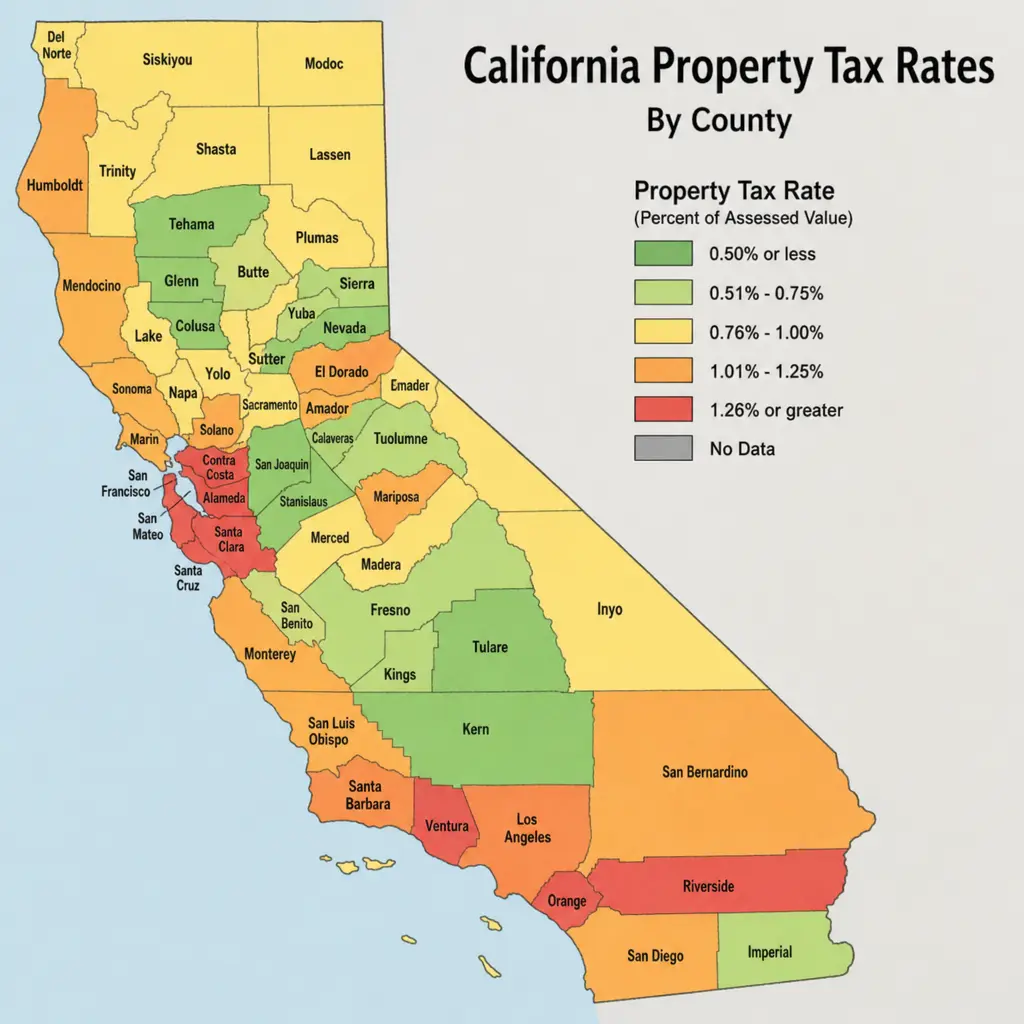
California Property Tax Rates by County & ZIP
California property taxes are easier to understand once you separate the statewide rule from the local add-ons. In most cases, property tax in CA starts with a 1% general levy on assessed value, then county, city, school, and special district charges can change the final bill.
· 8 min read