
Jackson County, Colorado Property Tax Guide
Property tax and hazard records for Jackson County, Colorado by ZIP code: assessments, lookup tools and the hazard factors behind them.
7 min read1,484 wordsZip Cost Ledger editorial
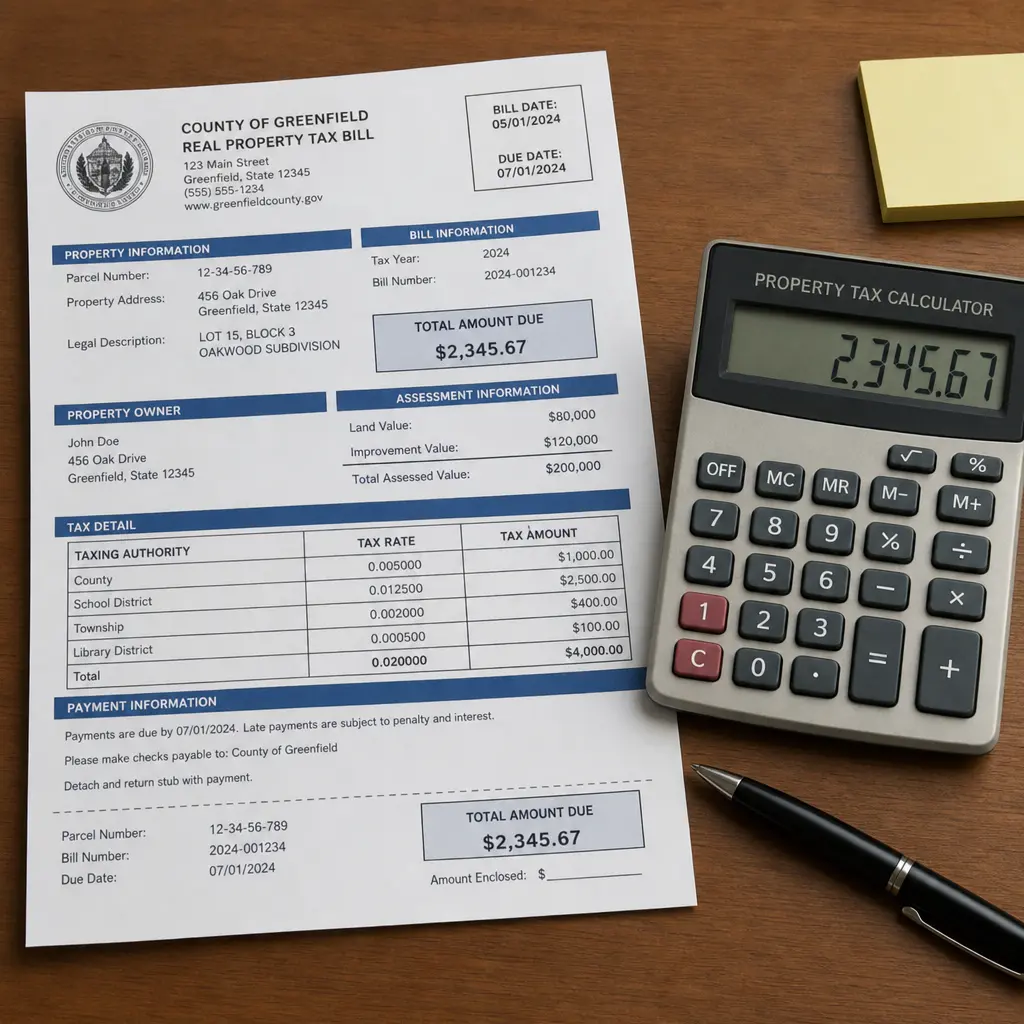
Property tax rates in a place called Jackson County can be confusing because there are many Jackson Counties, plus cities named Jackson in different states. This guide explains how Jackson County property tax rates are usually calculated, how to use a Jackson County property tax lookup, and why location, assessment rules, exemptions, and hazard considerations can change what a property owner actually pays.
county property tax bill and calculator on a desk
What determines your Jackson County property tax rate?
Your Jackson County property tax rate is determined by the taxing jurisdictions that serve your specific parcel, not by the county name alone. In most places, that means your bill may combine county taxes, school taxes, municipal taxes, fire or library district taxes, and special district levies. The exact mix depends on where the property sits.
That is why two homes with similar market values can have different Jackson County real estate taxes. One parcel may be inside a town, school district, or special district that another parcel does not share. A home inside city limits may also owe municipal taxes, while a rural parcel may only pay county and district levies.
The basic idea is simple: local officials set rates, the assessor determines taxable value, and the tax collector or treasurer bills and collects the tax. The details, however, vary sharply by state.
The basic property tax formula
Most property tax systems use a version of this sequence:
- Market or appraised value is established. The assessor estimates the value of the property under state and local rules.
- Assessment rules are applied. Some states tax only a percentage of market value.
- Exemptions or reductions are subtracted. Homestead, senior, veteran, agricultural, or other programs may reduce taxable value when a property qualifies.
- The local tax rate is applied. This may be called a mill levy, tax rate, or rate per $100 of assessed value.
- The tax bill is issued and collected. The treasurer, trustee, collector, or city revenue office handles payment.
In Colorado, for example, official state guidance describes property tax as being based on assessed value multiplied by a mill levy, with one mill equal to $1 per $1,000 of taxable value. (leg.colorado.gov) Tennessee explains the calculation differently but follows the same broad logic: local bodies set the rate, then the assessed value is multiplied by that rate. (tn.gov)
Jackson County, Colorado tax basics
If your search is specifically about Jackson County, Colorado — property tax and hazard by ZIP code, start with the parcel rather than the ZIP code. Jackson County, Colorado’s assessor provides an EagleWeb property search for assessment information, and the official listing identifies the assessor’s office in Walden. (eagleweb.jacksoncountyco.gov)
ZIP code searches can be helpful for narrowing a location, but they are not a substitute for parcel-level tax data. Jackson County, Colorado is commonly associated with ZIP codes including Walden, Coalmont, Cowdrey, and Rand. (zip-codes.com) Still, property tax districts do not always follow ZIP code lines neatly, so a Jackson County property tax lookup should be done by parcel, owner name, or property address whenever possible.
Hazard research is a separate but related step for buyers and owners. FEMA’s National Risk Index is designed to help identify communities at risk from natural hazards and includes data at county and Census tract levels. (catalog.data.gov) For a Colorado mountain or high-country property, hazard considerations may affect insurance, due diligence, mitigation planning, and long-term ownership costs, even when they do not directly change the property tax rate.
Why ZIP code alone can mislead buyers
ZIP codes are built for mail delivery, not tax billing. They may cross jurisdictional boundaries, include post office boxes, or cover areas with different taxing districts. That makes them useful for an early search but unreliable as the final source for Jackson County taxes.
For better accuracy, use this order:
- Parcel number: Best for exact property tax lookup results.
- Property address: Good when the parcel number is unknown.
- Owner name: Useful, but spelling and ownership changes can cause missed results.
- ZIP code: Helpful for broad research, but not enough for a final estimate.
This matters when comparing properties. A listing in one ZIP code may appear similar to another nearby listing, yet the tax bill can differ because of school district, fire district, town boundary, or special assessment differences.
Jackson, Tennessee property taxes are a different search
Searches for jackson tn property taxes usually refer to the City of Jackson in Madison County, Tennessee, not a county named Jackson. Madison County’s official property tax search page directs taxpayers to search and pay county taxes online, notes that assessments are made by the Assessor of Property, and states that the tax rate is set by the County Commission. (madisoncountytn.gov)
For properties inside the City of Jackson, city taxes may also apply. Madison County’s assessor FAQ explains that tax rates are established individually by the Jackson City Council and Madison County Commissioners, and that residential property is assessed at 25% of appraised value while commercial property is assessed at 40%. (madisoncountytn.gov) That means “city of jackson property taxes” and county taxes may both matter if the parcel is inside the city limits.
Madison County also provides an online estimator and clearly warns that actual taxes can vary based on final appraised value, classification, tax rates, exemptions, relief programs, special assessments, and other factors. (madisoncountytn.gov) In plain English: use online calculators as planning tools, not as final tax bills.
How to use a Jackson County property tax lookup
A Jackson County property tax lookup is most useful when you already know which state and jurisdiction you mean. There are Jackson Counties in several states, and search results can easily mix Colorado, Illinois, Georgia, Missouri, Tennessee-related Jackson city pages, and more.
Before you search, gather:
- The full property address
- The state and county
- The parcel or account number, if available
- The owner’s name as it appears on the deed
- The tax year you want to review
- Whether the property is inside city limits
Then confirm you are on an official county, city, trustee, treasurer, assessor, or tax collector website. For example, Jackson County, Colorado’s official assessor search is branded as EagleWeb, while Madison County, Tennessee provides separate county tax search resources for property taxes associated with Jackson, TN. (eagleweb.jacksoncountyco.gov)
Common reasons your bill changes
Jackson property taxes can rise or fall even if the posted tax rate looks stable. The rate is only one part of the bill.
Common causes include:
- A higher assessed value: Reappraisal, improvements, additions, or market changes can increase taxable value.
- A change in exemptions: Losing a homestead, senior, agricultural, or other exemption can raise taxes.
- A new local levy: Voter-approved bonds or district funding can add to the total rate.
- Annexation or boundary changes: Moving into a city or district boundary can add taxing authorities.
- Classification changes: Residential, commercial, agricultural, vacant, and personal property may be treated differently depending on state law.
- Special assessments or fees: Some bills include charges that are not the same as the base ad valorem tax.
For buyers, this is where many surprises happen. A seller’s current bill may reflect exemptions or classifications that will not apply after closing. Always ask whether the bill is based on the current owner’s status and whether a reassessment is expected.
A practical checklist before you buy or appeal
Use this checklist when reviewing Jackson County real estate taxes or comparing properties:
- Confirm the jurisdiction. Make sure you know the state, county, municipality, and school district.
- Pull the parcel record. Do not rely only on listing-site estimates.
- Review the assessed value. Compare land value, improvement value, classification, and exemptions.
- Check the tax year. Older bills may not reflect current rates or reappraisals.
- Ask about city taxes. This is especially important for city of Jackson property taxes in Tennessee.
- Look for unpaid balances. Delinquent taxes, interest, or fees can affect closing.
- Consider hazard and insurance costs. For Colorado properties, pair tax research with wildfire, flood, winter, and other hazard due diligence.
- Contact the office directly. If the numbers do not make sense, call the assessor, treasurer, trustee, or revenue office before making a decision.
The takeaway for Jackson County taxes
The phrase jackson county property tax can point to different places, so the first step is always geographic clarity. Once you know the exact county, city, and parcel, the process becomes much easier: verify the assessed value, identify the applicable tax rate, review exemptions, and use the official payment or lookup tool.
For Jackson County, Colorado, parcel-level assessor data is the better starting point than ZIP code alone. For Jackson, Tennessee, remember that city and county taxes may be separate pieces of the same ownership cost. In every case, the safest approach is to treat online estimates as a starting point and official tax office records as the source to verify before buying, budgeting, or appealing.
Related guides
New Jersey Property Tax Rates: County & ZIP Guide
New Jersey property tax rates can feel confusing because they are local, not statewide, and the number you see online may not be the number used to calculate your actual bill. This guide explains how NJ property tax works, why rates vary so much by municipality, and how to look up reliable property tax information NJ homeowners, buyers, and investors can use.
· 10 min read
Oregon Property Tax Rates by County & ZIP Code Guide
Oregon property taxes can feel confusing because there is no single statewide rate that applies to every home.
· 8 min read
New York Property Tax Rates by County and ZIP Code
New York property taxes are local charges based on a property’s taxable assessment, the budgets of the jurisdictions that serve it, and the tax rates adopted for those jurisdictions.
· 9 min read