
Oregon Property Tax Rates by County & ZIP Code Guide
Understand how Oregon county property tax rates work. Learn how assessed values, local districts, and bonds shape your bill instead of a single state rate.
8 min read1,693 wordsZip Cost Ledger editorial
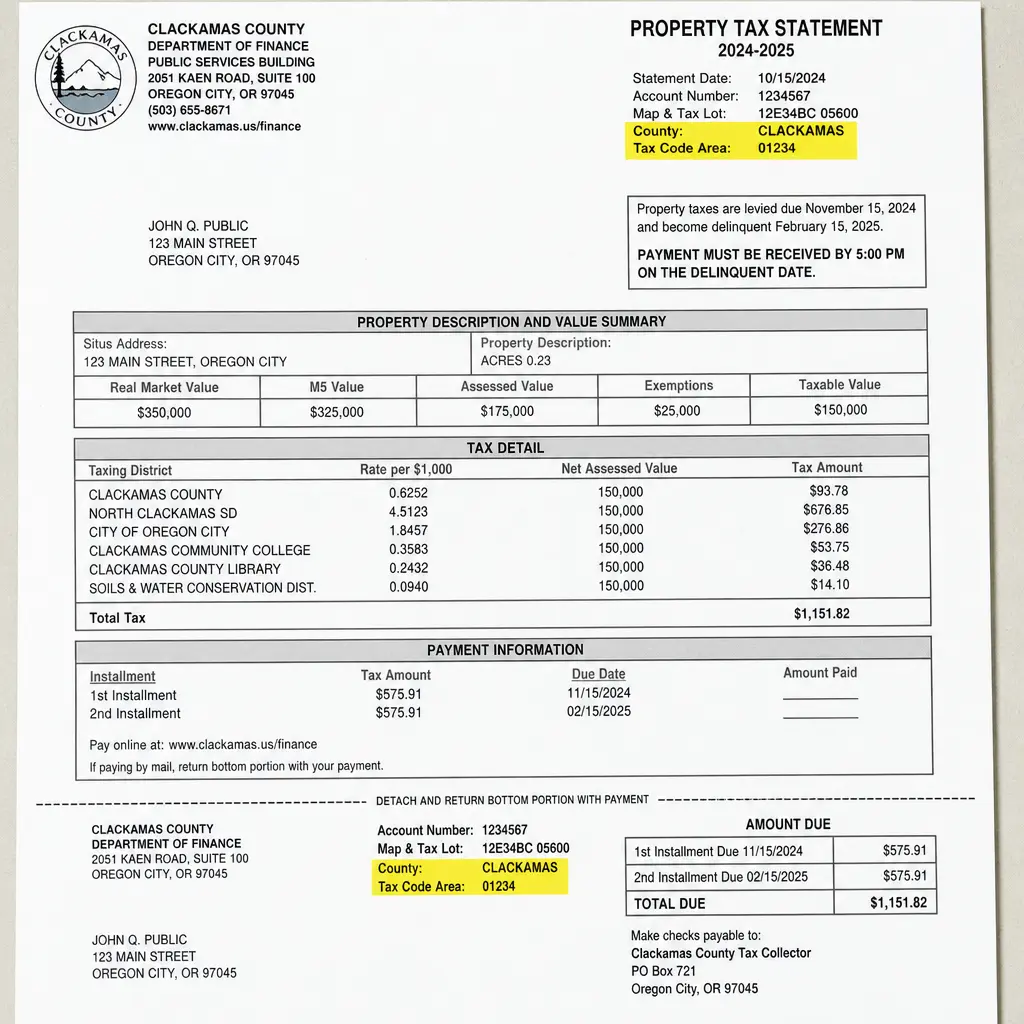
Oregon property taxes can feel confusing because there is no single statewide rate that applies to every home. Your bill depends on your county, your tax code area, the local districts that serve the property, voter-approved bonds, and the assessed value rules that limit how quickly taxable value can rise. This guide explains how Oregon county property tax rates work, how to compare locations, and how they fit into the broader picture of taxes in Oregon.
How are Oregon county property tax rates calculated?
Oregon county property tax rates are calculated by combining the rates of all local taxing districts that apply to a specific property, then applying that combined rate to the property’s assessed value. County assessors place taxes on the roll as a rate per $1,000 of assessed value, and the final bill can also include assessments or charges that are not simply a percentage of market value. (oregon.gov)
That means two homes in the same county can have different tax rates if they sit in different school, fire, library, park, urban renewal, or bond districts. A county name gives you a starting point, but the tax code area gives you the more precise answer.
A simplified property tax formula looks like this:
- Find the property’s assessed value.
- Identify every taxing district that applies to the property.
- Add the district rates together.
- Multiply the assessed value by the combined rate per $1,000.
- Add any special assessments or fees listed on the tax statement.
For example, if a property has an assessed value of $300,000 and a combined rate of $15 per $1,000, the rate-based portion would be about $4,500 before any added assessments. The exact bill may differ because Oregon’s system includes constitutional limits, local option levies, bonds, and county-specific tax statement details.
Oregon property taxes are local, not statewide
Oregon does not set one universal property tax rate for every homeowner. Counties administer assessment and collection, while cities, schools, counties, special districts, and voter-approved measures shape the total rate. The Oregon Department of Revenue notes that county assessment and taxation offices value property, calculate and collect taxes, and distribute money to local taxing districts. (oregon.gov)
This local structure is why a homeowner comparing Portland, Bend, Medford, Salem, Eugene, or a smaller rural community should avoid relying on a single statewide average. The better question is: what is the tax code area for the parcel, and what districts are included there?
Key factors that can change your tax rate include:
- School districts: Often a major part of the total rate.
- City or county services: Police, roads, planning, and general government can appear in different ways depending on location.
- Fire, library, park, port, or cemetery districts: Special districts can add rates in one neighborhood but not another.
- Urban renewal areas: These can affect how tax revenue is divided and may affect statements.
- Local option levies: Temporary voter-approved levies can fund operations for a limited period.
- General obligation bonds: Voter-approved capital bonds are commonly shown separately and may not be subject to the same limits as operating taxes. (oregon.gov)
Why assessed value matters more than market value
A common surprise for homeowners is that Oregon property tax is not based only on what a house could sell for today. Oregon uses assessed value, and assessed value is generally the lower of real market value and maximum assessed value. The state constitution limits growth in maximum assessed value to no more than 3% per year unless certain changes occur, such as new construction, improvements, partitioning, or subdivision activity. (oregon.gov)
This is why two similar homes can have very different tax bills. One home may have a much lower maximum assessed value because of its tax history, while a newer or significantly improved property may have a different assessed value path. A higher sale price alone does not automatically reset the property tax bill to market value, but construction or other qualifying changes can affect the calculation.
For buyers, the practical lesson is simple: do not estimate taxes only by multiplying the purchase price by a countywide rate. Look at the current tax statement, the assessed value, the maximum assessed value, and any planned improvements. If you are budgeting for a remodel, ask how new improvements could affect future assessed value.
Finding Oregon property tax rates by county and ZIP code
If you are searching for Oregon property tax rates by county and ZIP code, use county data as a broad comparison and parcel-level data for the real answer. ZIP codes are postal areas, not tax boundaries, so one ZIP code can cross city limits, school districts, fire districts, or even county lines. A ZIP-based estimate can be helpful for early research, but it should not be treated as final.
The most reliable path is to start with the county assessor or tax collector for the property’s county. The Oregon Department of Revenue also publishes annual Oregon Property Tax Statistics with county-level information and detailed data by taxing district, property class, and city code area. (oregon.gov)
Use this checklist when comparing properties:
- Confirm the county and parcel number.
- Look up the tax code area on the property record or tax statement.
- Review the combined rate per $1,000 of assessed value.
- Separate permanent rates, local option levies, and bond levies when available.
- Compare assessed value, not just real market value.
- Check whether a property is inside city limits or a special district.
- Ask whether any new voter-approved levies or bonds may affect future bills.
This approach works better than searching by ZIP code alone because property tax boundaries are built around local government districts, not mail delivery zones.
How Oregon property taxes compare with income taxes
Property tax is only one part of the Oregon tax picture. When people discuss the overall Oregon state tax burden, they often also mean income taxes, payroll-related taxes, local taxes in certain areas, and the absence of a general statewide sales tax.
The Oregon income tax rate is progressive, which means higher layers of taxable income are taxed at higher marginal rates. For the 2025 tax year, Oregon’s personal income tax rates run from 4.75% to 9.9%, depending on taxable income and filing status. The Oregon Department of Revenue explains that Oregon taxable income begins with federal taxable income and is then adjusted for Oregon additions, subtractions, and other modifications. (oregon.gov)
For 2025, single filers and married taxpayers filing separately use one bracket schedule, while joint filers, heads of household, and qualifying surviving spouses use another. The 2025 brackets include 4.75%, 6.75%, 8.75%, and 9.9% marginal rates, with the top 9.9% rate beginning above $125,000 of taxable income for single or married-filing-separately filers and above $250,000 for joint, head-of-household, or qualifying surviving spouse filers. (oregon.gov)
So when someone asks about the Oregon income tax percent, Oregon income tax percentage, Oregon state income tax rate, or Oregon state tax rate, the best answer is: it depends on taxable income and filing status. The top marginal rate is not the same thing as the effective rate paid on all income.
Property tax and income tax affect budgets differently
Property tax and income tax show up in different parts of a household budget. Property tax is tied to owning real estate and may be paid directly, through a mortgage escrow account, or indirectly through rent. Income tax is tied to taxable income and is typically paid through withholding, estimated payments, or a year-end balance due.
For homeowners, this difference matters when comparing counties. A lower home price does not always mean a lower tax bill, and a higher property tax rate does not always mean the property is less affordable. The assessed value, local district mix, insurance costs, mortgage rate, utilities, and commuting costs all affect the total monthly picture.
For relocating households, a useful budget review includes:
- Estimated mortgage payment or rent.
- Current property tax statement for the specific parcel.
- Expected Oregon income tax based on taxable income.
- Local payroll or transit taxes if applicable.
- Insurance, utilities, and HOA dues.
- Possible future changes from improvements or voter-approved measures.
This is also why a broad search for taxes in Oregon can produce mixed answers. Oregon may look different depending on whether you are focused on property ownership, earned income, retirement income, business activity, or day-to-day purchases.
Smart ways to compare counties before buying
When comparing homes across Oregon counties, start with real properties rather than averages. Averages can be useful for spotting general patterns, but they can hide large differences within the same county. A home inside a city with multiple overlapping districts may carry a different tax profile than a rural property only a few miles away.
Before making an offer, ask for or look up the most recent tax statement. Review the tax code area, assessed value, real market value, maximum assessed value, exemptions, and line items for bonds or local options. If you plan to build an addition, convert space, or make major improvements, contact the county assessor’s office to understand how the project could affect assessed value.
A practical comparison should answer three questions:
- What is the current annual tax bill for this parcel?
- Which districts and voter-approved charges are included?
- Could the bill change materially after purchase, construction, or a levy change?
The more specific your research, the less likely you are to be surprised after closing.
The bottom line on Oregon county property tax rates
Oregon property tax rates are best understood at the parcel or tax code area level, not just by county or ZIP code. County-level data can help you compare regions, but your actual bill depends on assessed value, local taxing districts, voter-approved levies, bonds, and Oregon’s constitutional assessed-value limits.
If you are buying, relocating, or planning a remodel, review the county tax statement and assessor record before relying on any estimate. Then look at the full Oregon tax picture, including the Oregon state income tax rate and other costs that may apply to your household. That combination gives you a clearer, more realistic view of what living or owning property in Oregon may cost.
Related guides
New York Property Tax Rates by County and ZIP Code
New York property taxes are local charges based on a property’s taxable assessment, the budgets of the jurisdictions that serve it, and the tax rates adopted for those jurisdictions.
· 9 min read

Montana Property Tax Rates: County & ZIP Guide
Montana property taxes can feel confusing because there is no single statewide bill that applies the same way to every home, ranch, commercial building, or vacant lot.
· 10 min read
Indiana Property Tax: County & ZIP Rate Guide
Indiana real estate taxes are local taxes, so the rate you pay depends on your county, taxing district, property type, deductions, and voter-approved charges.
· 9 min read