
Indiana Property Tax: County & ZIP Rate Guide
Discover Indiana property tax rates by county and ZIP code. Learn how local rates vary, and use tax lookup tools to ensure accurate property assessments.
9 min read1,748 wordsZip Cost Ledger editorial
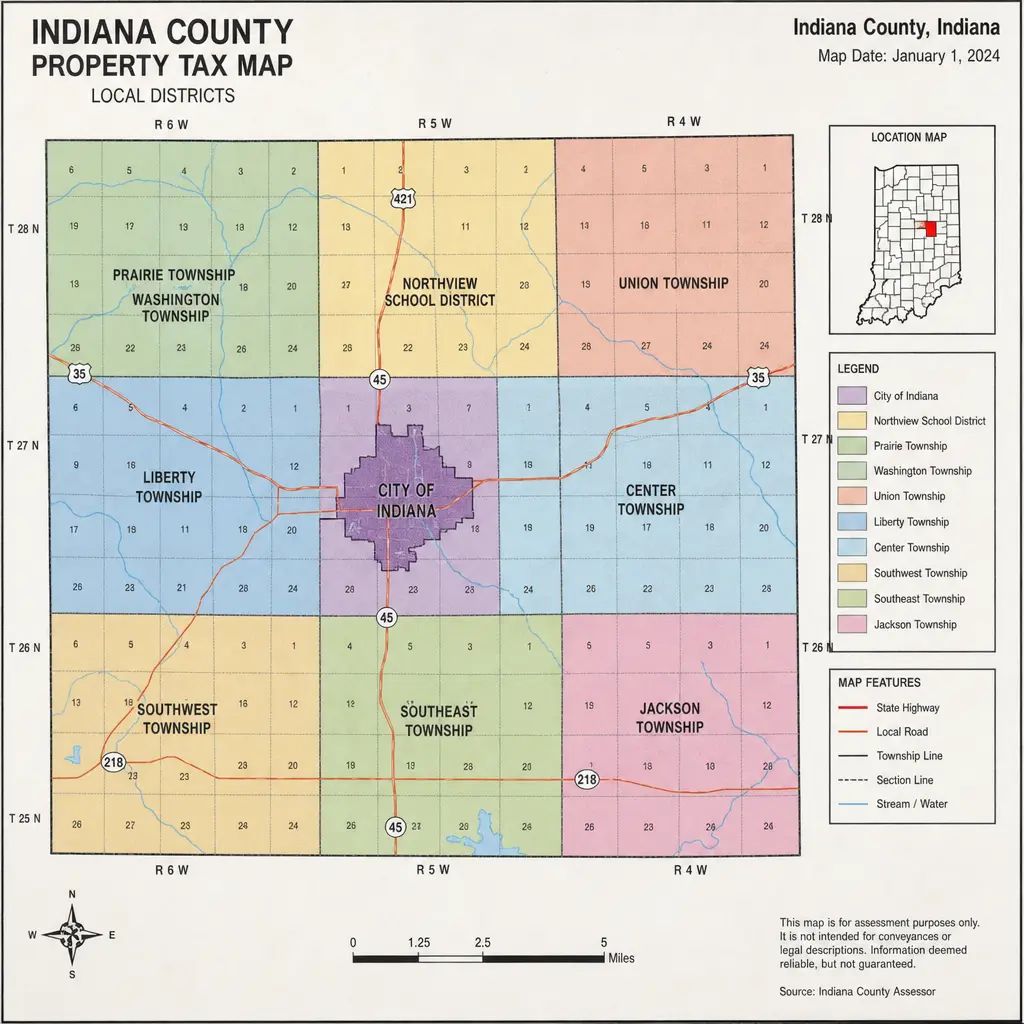
Indiana real estate taxes are local taxes, so the rate you pay depends on your county, taxing district, property type, deductions, and voter-approved charges. Indiana does not have one statewide property tax rate; instead, county and local governments certify rates that are applied to each property’s taxable value. This guide explains how Indiana property tax rates work, where to find Indiana property tax records, and how to make sense of county, ZIP code, and Indianapolis property tax searches.
What determines your Indiana property tax rate?
Your Indiana property tax rate is determined by the local taxing district where the property sits, not simply by the county name or ZIP code. A taxing district can include overlapping units such as the county, city or town, township, school district, library district, and other local units. Indiana’s Department of Local Government Finance explains that tax rates are calculated per $100 of net assessed value, which is the assessed value after applicable deductions. (in.gov)
That distinction matters because two homes in the same county can have different rates if they fall in different school districts, towns, townships, or special districts. ZIP codes can be even less precise because postal boundaries do not always match taxing boundaries. If you are comparing Indiana property tax rates by county and ZIP code, use the ZIP code only as a starting point and confirm the parcel’s actual tax district before estimating a bill.
The basic property tax formula
Indiana property tax bills are easier to understand when you separate the calculation into a few pieces. The exact bill can include credits, deductions, referendum amounts, and adjustments, but the core process generally looks like this:
- Start with gross assessed value. This is the assessed value assigned to the property.
- Apply eligible deductions. Common deductions reduce the taxable value, also called net assessed value.
- Apply the local tax rate. Indiana rates are applied per $100 of net assessed value.
- Account for credits and caps. Circuit breaker credits may limit the tax burden, while some charges may sit outside the cap.
- Review the final tax bill. The bill shows how much goes to each local taxing unit.
For a simple illustration, if a property has a net assessed value of $200,000 and the local tax rate is 2.00 per $100 of net assessed value, the basic gross tax would be calculated on 2,000 units of $100. That example is only a simplified estimate; the actual bill may change after deductions, credits, cap treatment, and local adjustments.
Indiana’s property tax caps shape the final bill
Indiana uses property tax caps, often called circuit breaker caps, to limit how much many owners pay compared with gross assessed value. The general caps are 1% for homestead property, 2% for other residential property and agricultural land, and 3% for other real and personal property. The caps limit the tax bill, but they do not change the local tax rate itself. (in.gov)
This is why a homeowner may see a high local rate but still receive a circuit breaker credit. The cap is applied after the tax is calculated, reducing the amount due when the bill exceeds the applicable percentage. However, not every charge is treated the same way. The DLGF notes that successful referendums may result in property tax amounts that exceed the caps, so a capped property can still see increases tied to voter-approved projects or operating funds. (in.gov)
How can you look up Indiana property tax rates by county and ZIP code?
The most reliable way to look up Indiana property tax rates is to search by county, taxing district, address, parcel number, or owner name through official state or county tools. The DLGF reports page publishes certified tax rates by taxing district, while Indiana Gateway offers tax bill and tax district lookup tools using data supplied by counties. (in.gov)
If you are starting with a ZIP code, treat it as a filter rather than the answer. A ZIP code may include multiple cities, townships, or school districts, and each can carry a different total rate. For buyers, investors, and homeowners checking an estimate, the better path is to identify the parcel first, then verify its county and tax district.
A practical Indiana property tax lookup process looks like this:
- Find the parcel. Use the property address, owner name, or parcel number in the state or county search tool.
- Confirm the county and tax district. Do not rely on ZIP code alone.
- Check the assessed value. Review both land and improvement values when available.
- Look for deductions. A homestead deduction, mortgage deduction, or age-based deduction can affect taxable value if the property qualifies.
- Review the certified rate. Match the parcel’s tax district to the certified rate for the correct pay year.
- Compare the estimate with the actual bill. Credits, caps, and referendum charges can make the final bill differ from a rough calculation.
County rates vary because local budgets vary
Indiana counties do not all carry the same tax burden because local budgets, school funding needs, debt obligations, assessed value bases, and voter-approved referendums differ. A county with a larger assessed value base may be able to raise needed revenue at a lower rate than a district with a smaller base. Meanwhile, a school referendum or local capital project can increase the amount property owners see on a bill even when the property’s assessed value has not changed dramatically.
This is also why “average” county rates can be misleading. A countywide average may be useful for quick comparison, but it can hide meaningful variation between districts inside the same county. If you are deciding where to buy, sell, or invest, compare actual parcels rather than broad county averages whenever possible.
Indianapolis property tax follows the same rules with local details
Indianapolis property tax is part of Marion County’s property tax system, but the exact rate still depends on the parcel’s tax district. Indianapolis and Marion County provide property tools that allow users to search property record cards by parcel number, state parcel number, owner name, or address. These records can show important details such as property class, assessed values, and tax district. (maps.indy.gov)
For Indianapolis homeowners, the most important items to review are the assessed value, deductions, and tax district. A home in one Indianapolis neighborhood may not have the same total rate as a similar home elsewhere in Marion County. Buyers should also check whether the property is receiving deductions that may change after a sale, because a prior owner’s tax bill may not perfectly predict a new owner’s bill.
What is the difference between property tax, state tax, and income tax in Indiana?
Indiana property tax is a local tax on real estate, while the Indiana state income tax rate applies to taxable income. For 2026, the Indiana individual adjusted gross income tax rate is 2.95%, and the state says it will adjust to 2.90% in 2027. County income tax rates are separate and may be adjusted in January and October, so the Indiana income tax rate a person experiences can include both state and local components. (in.gov)
This difference is important when people search for the Indiana state tax rate. The phrase can refer to income tax, sales tax, corporate tax, or another state-level tax, but it does not identify your property tax rate. Indiana state income tax rate information belongs on your income tax planning checklist; Indiana real estate taxes belong on your property ownership checklist.
Property tax records show more than a bill amount
Indiana property tax records can help owners understand how a bill was created. Depending on the county tool, records may include the parcel number, legal description, property class, land value, improvement value, total assessed value, tax district, exemptions or deductions, and payment history. The DLGF’s tax bill search notes that data comes directly from counties, so formats may vary across the state. (in.gov)
When reviewing records, look for details that affect the taxable value rather than focusing only on the final amount due. A bill can rise because the assessed value changed, a deduction was removed, a local rate changed, or a referendum amount applied. Understanding which factor moved is the first step toward deciding whether to budget for the change, ask the county for clarification, or review appeal options.
A homeowner’s checklist for reading an Indiana tax bill
Before assuming your bill is wrong or that your rate increased, walk through the main components in order. This keeps the review practical and helps you ask better questions if you contact a county office.
- Check the pay year and due dates. Make sure you are comparing the same tax cycle.
- Review gross assessed value. Confirm that the value shown matches the property and improvements.
- Review deductions. A missing homestead deduction can make a bill look unusually high.
- Identify the tax district. The district determines which local rates apply.
- Separate rate changes from value changes. Your bill can increase even if only one of those changes.
- Look for circuit breaker credits. These show whether the property tax cap reduced the amount due.
- Review referendum charges. Voter-approved amounts may be treated differently from capped taxes.
- Confirm payment status. Penalties can apply when property taxes are not paid on time.
Smart ways to estimate taxes before buying property
If you are shopping for a home or investment property, do not rely only on the seller’s current tax bill. The current owner may have deductions you will not receive, and the assessed value may change after a sale or reassessment. Indiana’s statewide cyclical reassessment process also means property data is reviewed over time, so values are not frozen indefinitely. (in.gov)
A better estimate starts with the parcel’s current assessed value and tax district, then considers how your ownership status may differ. For example, an owner-occupied buyer may qualify for a homestead deduction, while an investor buying the same property may not. If you need a close estimate, use official county or state tools and verify assumptions with the county auditor, assessor, or treasurer.
Key takeaway
Indiana property tax rates are local, parcel-specific, and shaped by more than a county name or ZIP code. To understand your bill, focus on the property’s assessed value, deductions, tax district, local rate, credits, and caps. For the best results, use official Indiana property tax lookup tools, confirm the parcel’s actual tax district, and remember that property tax is separate from the Indiana state income tax rate.
Related guides
Oregon Property Tax Rates by County & ZIP Code Guide
Oregon property taxes can feel confusing because there is no single statewide rate that applies to every home.
· 8 min read
New York Property Tax Rates by County and ZIP Code
New York property taxes are local charges based on a property’s taxable assessment, the budgets of the jurisdictions that serve it, and the tax rates adopted for those jurisdictions.
· 9 min read

Montana Property Tax Rates: County & ZIP Guide
Montana property taxes can feel confusing because there is no single statewide bill that applies the same way to every home, ranch, commercial building, or vacant lot.
· 10 min read