
California state income tax
How California state income tax works: filing statuses, marginal brackets, and what progressive rates mean for what you actually owe.
9 min read1,705 wordsZip Cost Ledger editorial
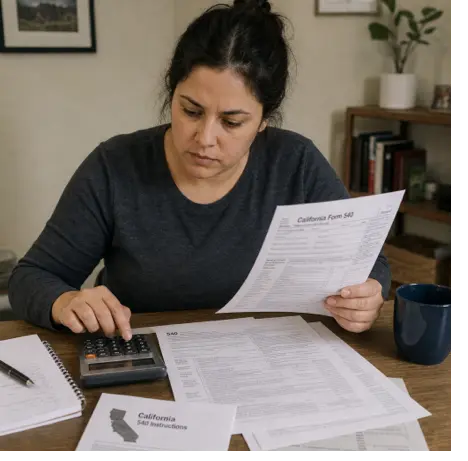
California uses a progressive income tax system, which means your tax rate rises as your taxable income moves through higher brackets. For most taxpayers, understanding the California state income tax starts with three things: your filing status, your California taxable income, and the tax year you are filing for. This guide explains how the rates work, how to read the brackets, when a California tax refund may happen, and how to use official tools without guessing.
How does California state income tax work?
California state income tax is based on taxable income, not simply your gross pay. The state starts with your income, applies California-specific adjustments, deductions, exemptions, credits, and payments, then calculates the tax due under the correct filing status. California residents are generally taxed on all income regardless of where it comes from, while nonresidents and part-year residents use different rules for California-source income. (ftb.ca.gov)
The important concept is “marginal” taxation. If your income reaches a higher bracket, only the dollars inside that higher bracket are taxed at the higher rate. Your earlier dollars remain taxed at the lower rates. That is why a raise, bonus, or side income can increase your total tax bill without causing all of your income to be taxed at the top rate you reach.
For 2025 California returns filed in 2026, the Franchise Tax Board lists tax rate schedules for taxpayers whose taxable income on Form 540, line 19 is more than $100,000; taxpayers at or below that amount generally use the tax table instead. (ftb.ca.gov)
The 2025 California tax brackets by filing status
The 2025 California tax brackets are organized by filing status. The rates range from 1% to 12.3%, with bracket thresholds that differ for single filers, married or registered domestic partners filing jointly, qualifying surviving spouses, and heads of household. (ftb.ca.gov)
For single filers and married/RDP filing separately, the 2025 california state income tax brackets are:
- 1% on taxable income up to $11,079
- 2% on income over $11,079 and up to $26,264
- 4% on income over $26,264 and up to $41,452
- 6% on income over $41,452 and up to $57,542
- 8% on income over $57,542 and up to $72,724
- 9.3% on income over $72,724 and up to $371,479
- 10.3% on income over $371,479 and up to $445,771
- 11.3% on income over $445,771 and up to $742,953
- 12.3% on income over $742,953
For married/RDP filing jointly or qualifying surviving spouse/RDP, the brackets are wider:
- 1% on taxable income up to $22,158
- 2% on income over $22,158 and up to $52,528
- 4% on income over $52,528 and up to $82,904
- 6% on income over $82,904 and up to $115,084
- 8% on income over $115,084 and up to $145,448
- 9.3% on income over $145,448 and up to $742,958
- 10.3% on income over $742,958 and up to $891,542
- 11.3% on income over $891,542 and up to $1,485,906
- 12.3% on income over $1,485,906
For head of household filers, the brackets begin at $22,173 for the first threshold and rise to the 12.3% bracket once taxable income is over $1,010,417. (ftb.ca.gov)
These figures are useful for planning, but they are not a substitute for completing the actual return. Credits, withholding, estimated payments, adjustments, and filing status details can change the final amount you owe or receive back.
Why your top bracket is not your effective tax rate
A common mistake is assuming your top bracket equals the percentage of total income you pay. In reality, your effective state income tax rate is usually lower than your highest marginal rate because the lower portions of your taxable income are taxed at lower percentages.
For example, if a taxpayer reaches the 9.3% bracket, that does not mean every dollar is taxed at 9.3%. The first dollars are taxed at 1%, then 2%, then 4%, and so on. The FTB’s own calculation method follows this structure: find the correct income range, subtract the lower bracket amount, multiply the excess by that bracket’s rate, then add the base tax for that range. (ftb.ca.gov)
This matters when you are making decisions about overtime, freelance work, investment income, retirement withdrawals, or year-end deductions. The question is not just “What bracket am I in?” but “How much additional tax will the next dollar create?” That is where a california income tax calculator can help.
What should you know before using a California income tax calculator?
A California income tax calculator is most useful when you enter California taxable income, not just your salary or gross income. The official FTB calculator for 2025 asks for filing status and California taxable income, and the FTB notes that it is for the 2025 tax year only. (ftb.ca.gov)
Before relying on a calculator result, gather the information that affects your ca income tax calculation:
- Your filing status. California usually uses the same filing status as your federal return, with special rules for registered domestic partners and certain exceptions. (ftb.ca.gov)
- Your California taxable income. This is the figure after California adjustments, not necessarily your federal taxable income.
- Your withholding and estimated payments. These do not change the tax rate, but they determine whether you owe or get a refund.
- Credits and exemptions. These can reduce tax after the bracket calculation.
- Residency status. Residents, part-year residents, and nonresidents may not calculate California income the same way.
The best calculators are planning tools, not final answers. If your income includes stock compensation, business income, multi-state wages, rental property, or major capital gains, the calculation may need more care than a quick estimate can provide.
Refunds, withholding, and the amount you actually pay
Your tax bracket tells you how the state calculates tax on taxable income. Your california tax refund depends on something different: whether your payments during the year were more than your final tax liability. Payments can include paycheck withholding, estimated tax payments, refundable credits, or other amounts applied to your return.
If your payments exceed what you owe, you may receive a refund. If your payments fall short, you may owe when you file. That is why two people in the same California tax brackets can have very different filing outcomes: one may get money back, while the other may need to pay.
The FTB says direct deposit is the fastest way to receive a tax refund and advises taxpayers to check routing and account numbers carefully so the bank does not reject the deposit. (ftb.ca.gov) The FTB’s current processing-time page lists personal refunds at about one month for e-filed returns and four months for paper returns, although extra review can take longer. (ftb.ca.gov)
To avoid refund surprises, review withholding whenever your life or income changes. A new job, marriage, divorce, dependent change, relocation, or substantial side income can all affect whether enough California tax is being paid during the year.
Practical ways to plan for California income tax
Good tax planning is less about memorizing every bracket and more about knowing which details affect the result. Use the brackets to understand your marginal rate, then focus on the items that influence your taxable income and payments.
A simple planning checklist:
- Review your most recent California return and note your taxable income, total tax, withholding, and refund or balance due.
- Compare your current-year income to last year, especially if you changed jobs or added self-employment income.
- Set aside money for California estimated taxes if withholding does not cover your income.
- Keep records for deductions, credits, estimated payments, and income reported on Forms W-2, 1099, K-1, or brokerage statements.
- Use the official FTB tax calculator for a quick estimate, then confirm with tax software or a qualified tax professional when your situation is complex.
- Recheck the current-year brackets before filing, because California tax brackets can change from year to year.
This approach helps you move from reactive filing to proactive planning. Instead of waiting until tax season to discover the result, you can estimate early, adjust withholding if needed, and reduce the chance of an unexpected bill.
Common California tax questions to keep in mind
California taxes are closely connected to federal returns, but they are not identical. Your federal adjusted gross income often feeds into the state return, yet California has its own adjustments, credits, forms, and rules. That means your federal refund or balance due does not automatically predict your California outcome.
Filing status is another area where assumptions can cause errors. The FTB generally instructs taxpayers to use the same filing status as the federal return, but registered domestic partners and certain taxpayers with nonresident spouses may have special treatment. (ftb.ca.gov) If your household situation changed during the year, review the filing-status rules before calculating tax.
Finally, remember that the rate schedule is only one part of the return. The final result comes after credits, payments, penalties if any, and refund or amount-due calculations. When in doubt, use official FTB resources and consider professional guidance for major life events or complex income.
Key takeaway
California’s income tax system is progressive, so your taxable income is taxed in layers rather than all at one rate. The 2025 california state income tax rates range from 1% to 12.3%, with brackets that vary by filing status. To estimate your real liability, start with accurate California taxable income, apply the right bracket schedule, account for credits and payments, and use official FTB tools when checking your numbers.
Common questions
Does moving into a higher bracket tax all of my income at that rate?
No. California's rates are marginal, so each bracket applies only to the income that falls inside it. Earning one dollar more moves that dollar into the higher bracket and leaves everything below it taxed exactly as before.
Which filing status should I use?
The status that matches your situation on the last day of the tax year, since that is the date California uses. Married couples may file jointly or separately, and the brackets for separate filers are not simply half the joint ones, so the two are worth comparing.
Do I owe California tax on income earned in another state?
A California resident is taxed on income from all sources, with a credit available for tax paid to another state on the same income. A non-resident owes California tax only on income sourced to California.
Related guides
Understanding Sales Tax Calculators: A Guide
A sales tax calculator helps shoppers, business owners, and bookkeepers estimate the tax added to a purchase before checkout or invoicing.
· 7 min read
Understanding PA Sales Tax: Rates & Compliance
Understand the complexities of PA sales tax, local rates in Philadelphia and Allegheny County, and how it compares with other states like Michigan and Indiana. Learn compliance tips to ensure proper collection and avoid errors.
· 9 min read
Master Kentucky Estimated Tax Payments: Avoid Penalties
Kentucky estimated tax payments help taxpayers pay Kentucky income tax during the year when enough tax is not being withheld from wages, retirement income, or other payments.
· 8 min read